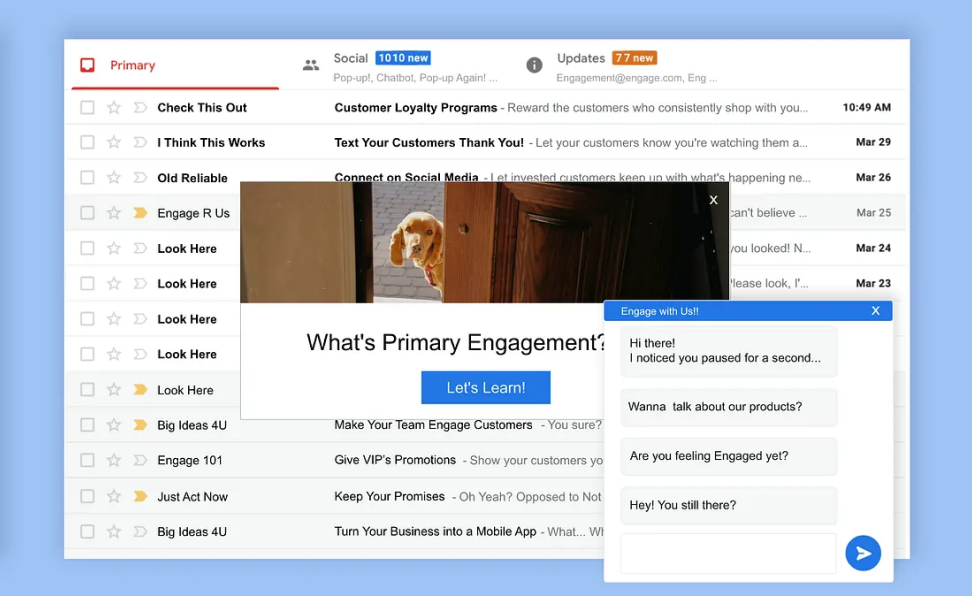
We can’t stop talking about Engagement. It’s clear why: Engagement has undeniable benefits1,2:
- Business Growth: Growing your customer base and profits
- Developing Customer Relationships: Customers becoming invested in your business
- Strengthening Customer Loyalty: Reiterating your business’ value to invested customers
While Engagement has remained a Marketing hot-topic for the last decade, the conversations on the subject remain rudimentary. Many articles talk about Engagement for Engagement’s sake; sharing general tips and tricks, minimally talking about Engagement’s overarching purpose, and rarely diving into the customer’s perspective.
These articles have had a noticeable effect; specifically, the domain of E-Commerce particularly tends to take the dire standpoint of “engage or die”4,5,6. This perspective has created an overwhelming online environment. The internet has become a constant din of aimless Engagement; businesses throwing the proverbial spaghetti at the wall, with minimal perceivable consideration or benefit for the customer. Let me be straightforward, this is aimless Engagement, and it negatively affects customers.
The 3 main issues with Aimless Engagement
- Guesswork solutions are a poor use of a business’ time, effort, and money: I’ve been a part of numerous start-ups who have all been completely overwhelmed with the prospect of starting their marketing journey. Unfortunately the resources accessible to new businesses often talk in aimless terms, not making the effort to educate people on the fundamental purpose and success metrics of their marketing endeavor. In this aimless marketing environment, many new businesses who are already stretching the value of a dollar see minimal results for their efforts.
- Customers learn to ignore businesses with poor Engagement: Aimless Engagement tactics regularly focus on keeping customer attention, with minimal concern for creating a positive user experience. A common example; daily emails that provide the customer with minimal value besides reminding them that the business exists. Tactics like this may work for now, but customers will use their selective attention to adapt:
Selective attention is really a survival instinct; if people had to pay attention to all stimuli in the environment, they’d never get anything done. They’d also be more likely to overlook something important, such as a big-toothed predator sneaking up on them.7 — Jakob Nielsen, NN/g
- Aimless Engagement can undermine your brand’s message: Actions are stronger than words. If a business’ brand messaging focuses on encouraging customers to feel relaxed, but said business engages with customers using pop-ups with headlines reading “URGENT”, that business is not practicing what it preaches. The primary function of Engagement is to communicate your brand’s psyche and value to the customer. If engagement is aimless, customers will “pick up” on inconsistencies between the company’s values and marketing strategy. Inconsistencies signal to the customer that the business isn’t truly invested in its brand message. At worst, customers could perceive this inconsistency as a business being untrustworthy — rendering all efforts in Marketing and engagement irrelevant.
In this series of articles, I will outline the process of achieving what I call “Essential Engagement”. Essential Engagement employs User Experience (UX) methods to find the crucial points of communication between businesses and customers (required by any business to reach and maintain any level of success).
Many of the topics throughout this series are applicable to other Engagement platforms (email, social media, etc) and Engagement purposes (philanthropy, self-promotion etc.). Still, I believe Essential Engagement starts with a business’ website. Besides a physical store-front, your website is the most direct way a customer can interact with your business. Customers make major decisions on your website; whether they will align themselves with your business, or not. Whether they will purchase your product, or not.
An Engaging website should be the first, and most powerful step you take towards creating positive communication between you and your customers.
What is Customer Engagement?
Engagement: A general definition
Here’s a synthesized definition of engagement, created mostly thanks to these two articles9,10:
Engagement is defined as a business making the effort to engage (through their website, social media, email, etc.) with their customer, in order to reiterate their brand’s worth.
“Engage” is somewhat vague. What does it mean to engage11 with another person?
- To attract or involve someone.
- To establish a meaningful connection, emotional involvement.
- To make a promise, a guarantee, or commitment.
- To offer something, such as one’s word, as backing to a cause or aim.
Engagement: Who’s involved and what do they do?
Truly Engaging customers requires a coordinated effort between Marketing and UX Design:
- Communicating Engagement through Marketing
- Setting the Tone: Marketing works to communicate the values and experience the customer can expect when interacting with the business and the products.
- Demonstrating Engagement through User Experience (UX) Design
- Proves Business Values: UX Design demonstrates the promises made by marketing initiatives through the implementation of numerous positive customer interactions.
| Marketing: Engagement through Communication | UX: Engagement through Demonstration |
|---|---|
| Communicating a message that shows the company’s values and promised experience. | Creating experiences that represent the business’ “psyche” and values. |
| Eg: A school supplies store: “Making back to school simple! We’re the one-stop shop for busy parents.” | Eg: Developing a list of the most commonly purchased “back to school” items and putting it at the top of your website. |
| Making guarantees about your products and/or services to communicate that your business is trust-worthy. | Making it easy for customers to understand the specifics and any complicated details of your guarantee. |
| Eg: “We offer a lifetime guarantee for every one of our products. We want you to be happy for a long time.” | Eg: Making your repair and return policies easy to find on your website. Ensuring the policies are easy to read in all their detail. Giving your customers peace of mind. |
Businesses need to both communicate and demonstrate engagement in order to successfully engage with their customers.
If a business communicates (marketing) but doesn’t demonstrate (UX design) Engagement; they’re “all talk, and no action”, failing to satisfy the guaranteed value to their customers. If a business demonstrates (UX design) but doesn’t communicate (marketing) engagement; the customer cannot effectively discern a business’ value, the business will struggle to find customers and succeed.
In this article (as well as the next one) I’ll be focusing on UX Design, or demonstrating engagement, as the Marketing-side is heavily documented elsewhere.
Engagement: How does the customer fit in?
Positive customer interaction + customer loyalty = great customer engagement. The customer is only “loyal” if they share similar values with the business or if they find value in the business’ services.
The Two Levels of Engagement
Now that we have a definition, we can talk about the two major types of engagement and their respective goals; I’ve defined them as Essential Engagement and Targeted Engagement.
New businesses can learn how to engage with their customers using Essential Engagement, while Targeted Engagement supports mature businesses who have zeroed in on their client’s wants, needs, and values.
Level 1: Essential Engagement, aka “Basic Manners”
Essential Engagement employs UX Design fundamentals to show basic respect for all customers’ time and effort. This style of engagement is known as “basic manners” because it’s tailored to communicate with the widest variety of people, not just one particular group of customers. Essential Engagement is business “small talk” — its purpose is to communicate your most basic and key information to a wide variety of customers.
Key information can include: industry, a basic description of services, hours of operation, values, contact information, locations, main products, return policy, shipping policy, etcetera.
3 Benchmarks of Essential Engagement:
- Supportive: Make each step from research, purchasing, and customer support as seamless as possible.
- Clarity: Clearly displaying critical business information (e.g. FAQ, returns policy) and product information (prices, sizes, etc.), so customers can efficiently understand your services.
- Trustworthy: The business demonstrates transparency regarding exchanges between the customer and business — e.g. clear return policies, well designed FAQ pages, etc.
Who is Essential Engagement for?
- All businesses that are looking to provide positive customer engagement.
- New businesses who may not have a complete grasp on their place within their consumer market.
Level 2: Targeted Engagement, aka “branding”
Generally, the purpose of Targeted Engagement is to make a memorable connection with the specific group of customers who are most receptive to your branding, services, and business values. Targeted Engagement requires sustained research and effort — the execution is different for each business. For example, the best way to Engage with Heinz customers looks different from the best way to Engage with Adidas customers. Less ketchup, more shoes.
There are no short-cuts to Engagement. Engagement requires businesses to both communicate and demonstrate respect and dependability to their customers. Through UX Design and Essential Engagement we can remove the guesswork of customer communication; creating a connection with your customers that results in genuine loyalty.
Citations
- Casey Briglia. (August 20, 2020). Why Customer Engagement Is Important. Gartner.
- Micah Solomon. (December 24, 2015). Customer Engagement Is Everything In Business. Forbes.
- Data source: Google Trends.
- Brett Relander. (December 9, 2014). Too Much Social Media Can Drive Away Your Customers. Entrepreneur.
- Shep Hyken. (February 21, 2021). Customer Engagement Is Your Secret Weapon To Beat The Competition. Forbes.
- Ada Okoli. (December 19, 2017). 2018: The Year of The Overwhelmed Customer. Zoovu.
- Jakob Nielsen. (August 26, 2012). Tunnel Vision and Selective Attention. NN/g.
- Amy Schade. (March 4, 2014). Designing for 5 Types of E-Commerce Shoppers. NN/g.
- Alex McEachern. (May 11, 2019). What is Customer Engagement, and Why is it Important?
- Swetha Amaresan. (July 30, 2019). The Ultimate Guide to Customer Engagement. HubSpot.
- Merriam-Webster.com Dictionary. (2021). Engage.